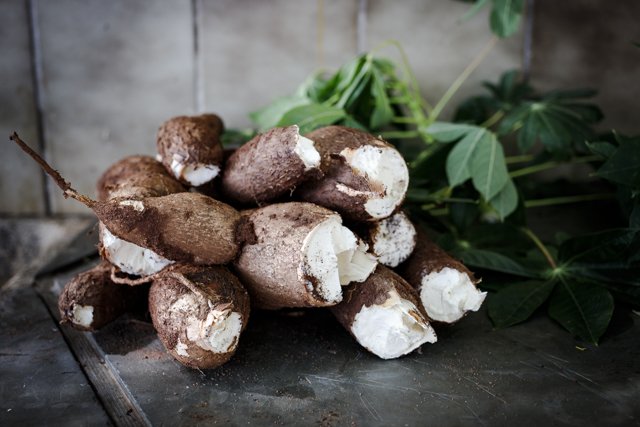
In our previous article, we wrote about what native Brazilians ate. One of the most important staples for them was cassava. Not only because it is a very satisfying and nutritious root, but mostly because it could be easily harvested and transformed into flour when migration was necessary.
Researching about cassava and the way native Brazilians cultivate was a significant effort. It wasn’t easy to find much information about it at first, probably because of the language barrier between the colonisers and many tribes speaking their own language. With time we could track down papers and interviews that brought some light to this subject.
To get to the point of mastering the cultivation of cassava, native Brazilians had a long period of domestication and development of the crop. Some would say that it took thousands of years of work to domesticate and develop the cassava crop. There are not many studies to identify how it happened exactly, as the country was invaded in 1500, and all we have from that time are reports from explorers. They wrote down only what they saw, as can be verified in texts such as “Viagem ao Brasil 1865-1866” by Luiz Agassiz and Elizabeth Cary.
For a long time, European historians ignored the importance of cassava, focusing more on wheat, rice and corn as the staple food of civilisation. Often cassava wasn’t included in their studies because it came from people whose culture was considered primitive and mediocre. The historian Jaime Rodrigues, in his article about cassava, noticed that even when mentioned, cassava flour used to be highlighted for its rusticity, and its inventors were defined as wild Indians.
Fortunately, a movement of part of historiography, at least the one that focused on Brazil, brought relevant contributions to modify this type of view. In this sense, one cannot ignore how Barickman approached the subject of cassava farming and flour production. Pointing out that cassava is one of the staple foods for about 800 million inhabitants of the tropical zone, Alfred Crosby, revisiting his classic study on food exchanges, acknowledged that the Amerindians “developed their own agricultural technique and domesticated a good number of our most valuable edible plants: corn, potatoes, sweet potatoes, manioc, various vegetables, tomatoes, cocoa… without which the rise of modern civilisation would have been very difficult.”

Moving forward, we found a study on Indigenous Agriculture by Raimundo Nonato Brabo Alves for Embrapa. In the document there is a description of how some tribes developed the cultivation of cassava.
Many indigenous tribes ran sophisticated agricultural systems that ranged from knowledge of agricultural calendars based on astrology to methods of soil selection and management, and crop diversification. The Desana people (who inhabit the Tiquié River – an affluent of Rio Negro in the Amazon region), established a calendar of farming activities, determined by the appearance of constellations and occurrence of rains.
The Munduruku people developed advanced farming techniques using empirical knowledge, which today correspond to areas of expertise such as topography, drainage, granulometry and soil fertility. The following sequence characterised the agricultural activity of the Mundurukus:
- Choice of area and quality of the land;
- Determining the size and shape of the swidden;
- Drill;
- Clearing the forest;
- Burning coivara*;
- Digging and planting;
- First and second sweepings;
- Cutting of the swidden (pulling out the cassava, harvesting);
- Replanting the garden (Frikel, 1959).
*Coivara is an agricultural technique used in traditional communities such as quilombolas, indigenous, caiçaras and riverside communities in Brazil. It is also called itinerant agriculture and is generally defined by a few years of cultivation, followed by many years of rest. The plantation includes the cutting and burning the native forest, where fire plays a fundamental role. Then, there is the intercropping of several crops (crop rotation), such as cassava, corn and beans, for 3 years and, mainly, soil rotation to improve fertility and control pests.
The planting carried out by the Mundurukus Indians was done with the participation of men and women. The men opened the pits with a “digging stick”, which consisted of a sturdy stick approximately 2 meters long, pointed at the bottom. Today, producers in the Amazon call this planting artefact inherited from the indigenous people “espeque” and still use it for planting corn and beans. This rod was pushed into the ground with an inclination of 30 to 40 degrees, later displacing it to the vertical position, thus opening a small pit, in which the woman placed two or three stems. Taking the tip of the stick out of the hole, the woman stepped on top to close it and to squeeze the soil, leaving out the upper tips of the branches, for the development of branches and leaves (Frikel, 1959).
I think all that research and reading is giving us the knowledge we need to understand and value the Brazilian cuisine from its roots and its original people. Next time we will start to explore the processing and byproducts of cassava. See you soon!
Leave a Reply